Asian Recipes and French Wine Pairings: 3 Perfect Matches with Burgundy and Alsace Wines
A Sneak Peek into French Gourmet Expertise — Made Approachable
ToggleSummary of the Asian recipes and French wines and food pairings detailed in this article :
8 minutes to read the full article
Coconut milk and red curry paste shrimps together with Pouilly Fuissé Chardonnay from Burgundy
Chinese pork dumplings paired with a Gewurztraminer – Alsace white wine
Ginger monkfish skewers along with Saint Véran Chardonnay from Burgundy
Why Asian Food and Wine Pairing Can Be Challenging
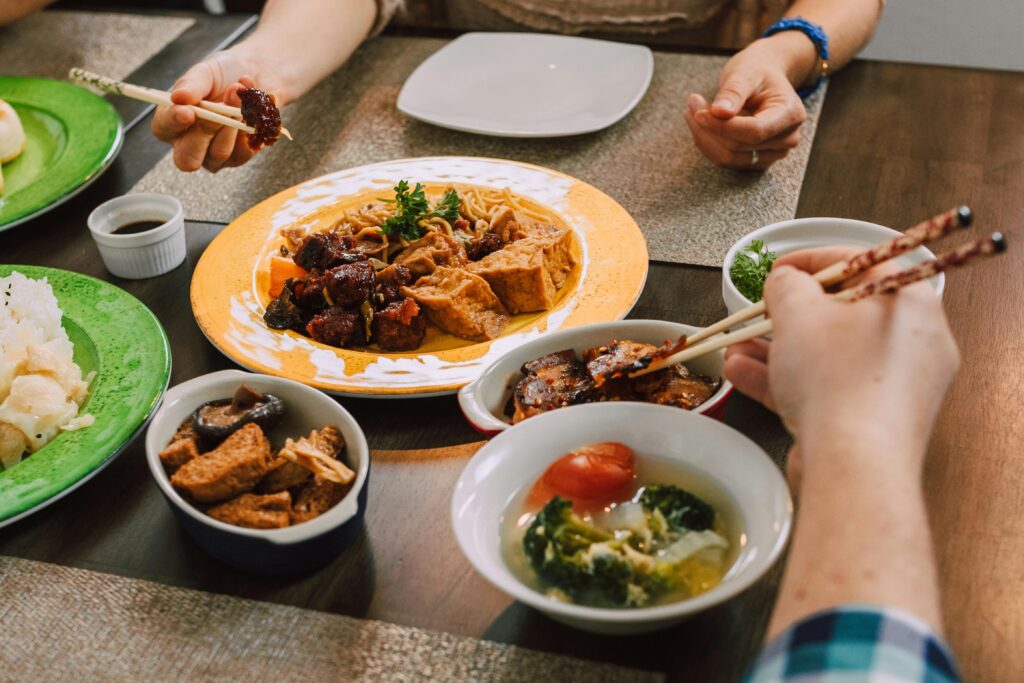
Asian cuisine is a playground of aromatic intensity : spices that bloom in hot oil, coconut creamy textures, ginger heat, sweet and savory contrasts, and that irresistible umami depth.
But when it comes to wine and food pairing, as these bold flavors with French wines, then hesitation often replaces confidence. Too spicy ? Too aromatic ? Too rich ? Many wine lovers simply don’t know what to choose.
In this article, I share three of my favorite Asian-inspired recipes. Shrimp noodles with coconut milk and red curry paste, Chinese pork dumplings, and ginger monkfish skewers. Each paired with a carefully selected French appellation.
The goal is simple:
knowing what to choose, knowing when to taste it, and buying with confidence.
Why Asian Cuisine Works with French Wines ?
Asian cuisine offers an incredibly wide spectrum of flavors: salty, fruity, sweet and sour, umami, caramelized, peppery, and spicy. As an example, each province of China brings its own culinary identity, techniques, and flavor balance and freshness, creating remarkable diversity across dishes.
Interestingly, the diversity of French wines reflects this same richness. From dry, crisp, fruit-forward wines to mellow, generous, and indulgent styles, France offers a wine profile for every flavor expression found in Asian cooking.
Let’s explore how French beverage Burgundy chardonnay and Alsace white wine can elevate these vibrant Asian recipes into refined, memorable tasting moments.
Coconut milk and red curry paste shrimps
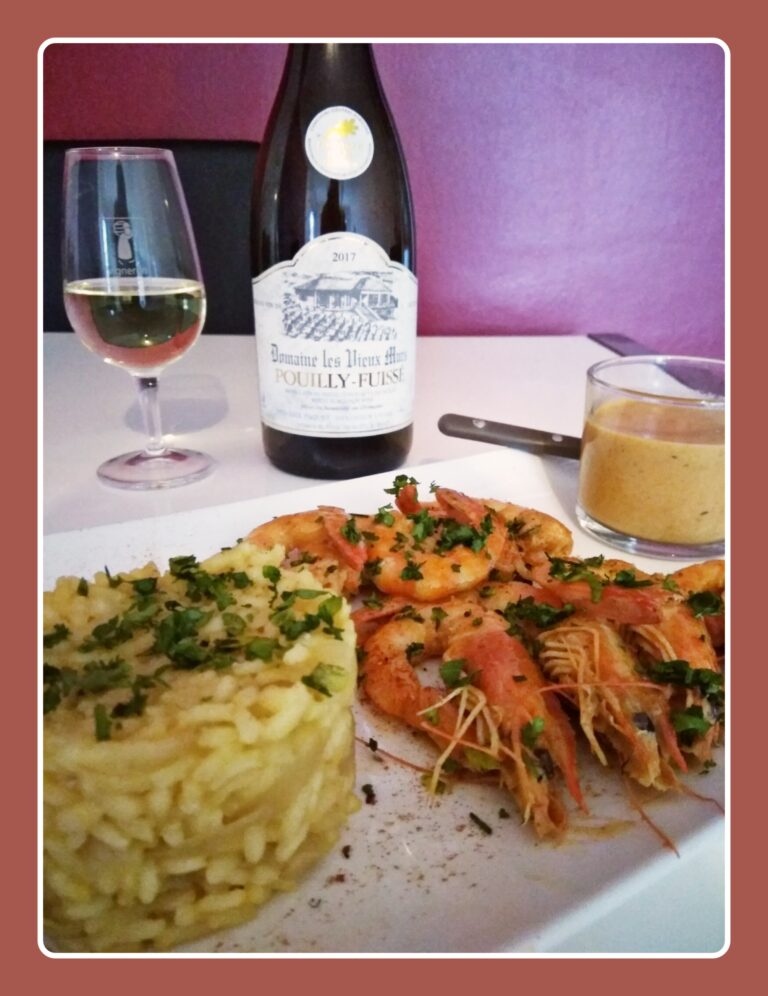
This recipe is inspired by Thailand typical cuisine. I have seen native Thaï persons putting as well nuoc mam and suggar in the recipe but I wanted to replace these aromas close to sweet and sour effect with more aromatic intensity of spices such as garam massala and cumin.
In this way the dish keeps the consistent tasting line conveyed by the coconut milk and the red curry paste. To enjoy this recipe you can pick up a nice Burgundy chardonnay with aromatic intensity, strong structure, round and rich texture, without discarding fresh citrus notes which are important to balance the creamy texture of the sauce.
Ingredients for 4 persons
- 10,5 Oz of shrimps
- 0,05 Gal of coconut milk
- 2 table spoons of red curry paste (1 if you fear chilli pepper strength)
- 1 garlic clove
- Chives
- Cilantro
- 12,4 Oz of noodles
- 2 tea spoons of garam massala
- 1 tea spoon of cumin
- Olive oil
Instructions
1. Cut thinly the garlic clove. Put the spices in a frying pan and only the spices. Heat the frying pan at full blast and wait for the very first small smoke airing out of the pan. Right at that moment add the olive oil and the garlic. Decrease the heat to small strenght and keep it 20 seconds stiring the spices and garlic.
In this step the main thing is to torrify the spices without burning it. That is the reason why you have to catch the first small smoke out of the pan. And pour the olive oil at once and decrease the heater to avoid burning the spices.
2. Once the spice torrified and integrated into oil, put the shrimp to be cooked for 2 minutes at medium heat (it will be fair enought as shrimps are often sold already cooked). In case the shrimps were raw, just let it cook 5 minutes at medium heat and it will be done.
3. Than add the coconut milk with the red curry paste. Knead it so that curry paste dissolve into the coconut milk. Let it cook 2 minute at low heat.
4. Cut thinly the chives and the cilantro and put it in the frying pan. If you want the dish to be a bit more fresh just add the juice of half a lime.
5. Boil a pan of water and when boiling add the noddles and take the pan out of the heater. Cover the pan and let the noddle cook for 3 to 4 minutes. This is usually the way to cook it but check on the noddle package the preparation inscriptions to make sure your noodles will be ready.
6. When the noodles are cooked put it in the frying pan or a wok would be perfect with the shrimp and the sauce. Melt it so the sauce is spreadt equally all over the noodles.
Serve the dish hot with a Pouilly Fuissé from Burgundy.
Pairing Asian Food With Burgundy Wines : Pouilly Fuissé C.D.O from Burgundy
First of all, this is a dish with real opulence: a strong aromatic intensity, powerful spices, and a rich, creamy texture brought by the sauce. It calls for a wine that can rise to the occasion — one with equally pronounced aromatic intensity and a structured, full-bodied profile that mirrors the dish’s richness, while also offering slightly mellow citrus notes to lighten the overall experience.
Pouilly-Fuissé proves to be an excellent choice according to these criteria. Its delicate citrus aromas, especially refined notes of grapefruit, refresh the coconut milk sauce beautifully. Meanwhile, its white-fleshed fruit notes highlight the ginger while gently softening the spices of the red curry paste.
Foodie Tasting Newsletter
French Wine Tasting & Pairing Tips Twice-Monthly
Thank you!
You have successfully joined our subscriber list.
Steamed Chinese Pork Dumplings (Perfect for Lunar New Year)
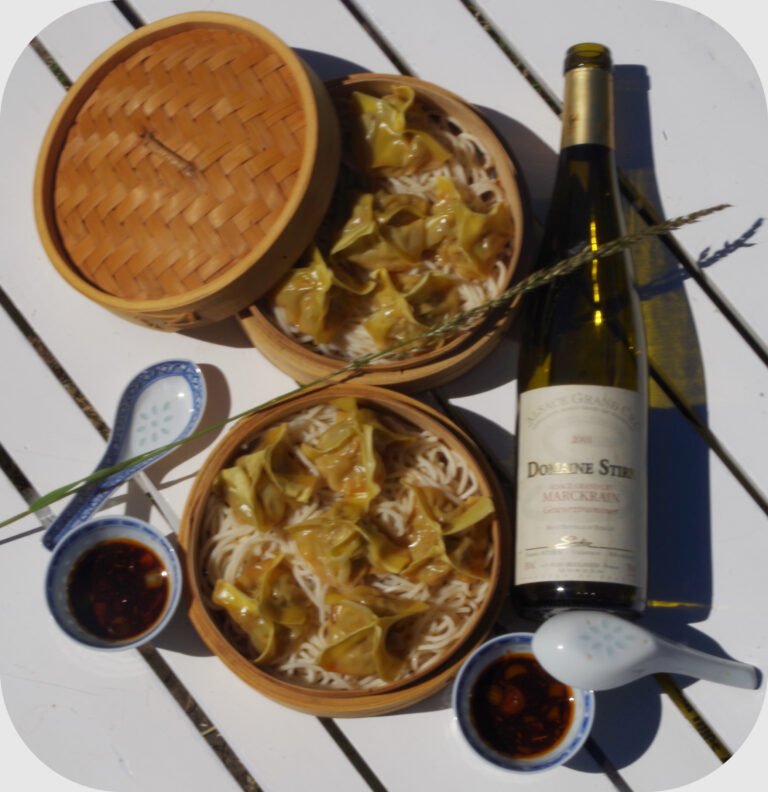
This recipe is a must, once you tried it you simply ask for more. Sometimes the stuffing is gathereing pork and shrimp within the ravioli, but here I wanted to keep straight flavor of pork. And instead of expanding toward sea food I reinforced pork taste by focusing on spices to elevate the dish instead of getting lost between reef and beef flavors.
With such aromas and spices, you can pair these dumplings with Gewurztraminer from Alsace white wine : an aromatic intensity features wine for an intense dish both bold and full of flavors.
Ingredients for 4 persons
21 oz pork loin, cut into cubes
1 garlic clove, finely chopped
1 tsp garam masala
½ tsp ground coriander
½ tsp turmeric
4 cardamom seeds
Olive oil
½ tbsp hoisin sauce
4 tbsp soy sauce
2 tbsp teriyaki sauce
1 tbsp yakitori sauce
2 tbsp honey
1 tbsp sesame oil
Dumpling wrappers (small square sheets)
1 small bowl of water (for sealing)
Instructions
1. Heat a frying pan on high and add only the dry spices. Toast them until a light smoke appears, being careful not to burn them. Lower the heat, add enough olive oil to lightly coat the pan, then add the chopped garlic and let it infuse gently for about one minute.
2. In a bowl, mix the hoisin sauce, soy sauce, teriyaki sauce, yakitori sauce, honey and sesame oil until smooth. Pour in the warm spiced oil and stir well so the flavors blend together.
3. Blend the pork cubes with the sauce until well combined, keeping a slightly textured consistency. Transfer the mixture to a bowl, cover and let it marinate for at least 6 hours, ideally overnight for a deeper flavor.
4. Place one dumpling wrapper on a flat surface and lightly moisten the edges with water using your finger. Add one teaspoon of marinated pork in the center. Fold two opposite corners toward the middle, then fold the remaining two corners to the center and seal tightly once all corners are gathered in the center. Repeat until all the filling is used.
5. Line your steamer with baking paper and arrange the dumplings inside, leaving a little space between them. Steam for 10 to 15 minutes. They are ready when the wrapper becomes slightly translucent and reveals the filling.
6. Serve with soy sauce mixed with a little sriracha for dipping. Enjoy with noodles or Cantonese rice, and pair beautifully with a glass of Gewurztraminer for a floral and slightly spicy food pairing.
Why Alsace Wines Work So Well With Asian Food : Gewurztraminer C.D.O from Alsace
Orange zest and honey bring a generous sweetness that balances the slightly acidic edge of the sauce while smoothing its savory notes.
Mango and passion fruit help soften the salty character of the sauce, giving it a warm, sun-kissed expression.
The wine’s round, coating and fairly rich creamy texture wraps around the meat, filling the palate and gently guiding the chew toward the tender, comforting side of the filling.
Ginger monkfish skewers
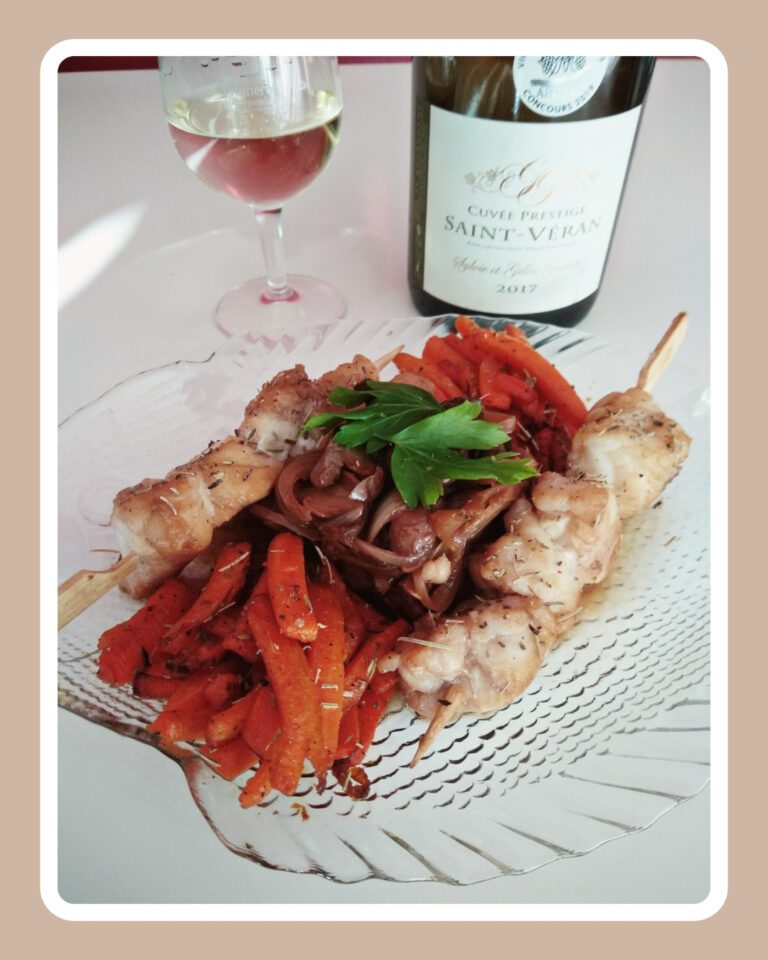
This dish is among the top fish recipes of Asia to me. First because it uses monkfish which has one of the richest and more enjoyable creamy texture of flesh. Actually I cook it like this as it is the only fish flesh that can hold and remain whole in spite of the skewers piercing the fish. Plus the texture of the monkfish is just incredible, very round and fat.
It calls for dryer sensation in mouth to avoid being overwhelmingly thick and pasty while tasting. So a good Saint Véran will perfectly match this call with its Burgundy chardonnay.
Ingredients for 4 persons
4 monkfish steaks of 7 Oz each
6 think slices of ginger
3 table spoon of olive oil
For the sauce :
4 perfumed mushrooms
2 onions
1 piece of raw ginger of 0,4 Inch long
1 schallot
3,52 Oz of cooked pork
1,23 Oz of duck fat
4 table spoon of chicken browth
3 table spoon of soja sauce
2 table spoon of Chao Xing or Xérès
Salt
White pepper
Instructions
1. Soak the mushrooms for 30 minutes in warm water. Drain them, remove the feet and cut the heads into very thin slices.
2. Wash and dry the monkfish steaks. Salt them, pepper them and brush them with a little oil. Let stand for 30 minutes
3. Peel and finely chop the onions and the shallot. Grate the piece of ginger. Chop the pork.
4. Brown onions, shallots, mushroom, ginger and pork in goose fat
5. Bring the chicken broth, soy sauce and chao-xing to a boil. Put this mixture in the pan and cook for 1 minute while stirring. Keep this sauce warm.
6. In a pan, heat the remaining oil. Fry the ginger slices for 1 or 2 minutes.
7. Add the monkfish and sear it for 3 to 5 minutes on each side. Lower the heat and cook for 10 minutes, stirring the steaks. Season with salt and pepper.
8. Arrange the monkfish steaks on a shallow dish, drizzle with sauce and serve. You can eat it with a side dish as cantonese rice or chop suey vegetables. For the wine and food pairing, I suggest a Saint Veran, Burgundy chardonnay.
Pairing Asian Cuisine with Burgundy Wines : Saint Veran C.D.O from South Burgundy
Aromas of quince and pineapple pair beautifully with ginger, creating a natural aromatic bridge with the dish. Fresh citrus notes, especially mandarin, gently lighten the rich creamy texture of monkfish.
White flowers aromas, verbena and linden blossom lift the flavors into a more vegetal, airy universe, enhancing balance and freshness while bringing elegance to the plate.
Want more seafood and wine pairing moments. Fond of briny flavors underlined by fresh and vibrant French wines. Don’t hesitate to take your apéritifs to the next level: download the free fish rillettes recipes and wine pairing guide by subscribing to our Newsletter. You will get easy wine and food tips without the jargon without compromissing on quality.
The Secret to an Unforgettable Aperitif
Download your free tasting guide to simple, elegant finger foods that feel restaurant-worthy.
- Ready in minutes : Simple ingredients, zero complex techniques.
- Perfectly paired : Discover the exact fresh, lively white wines to balance every bite.
- Host with confidence : Spend less time in the kitchen and more time enjoying your guests
Thank you!
You have successfully joined our subscriber list. You are redirected toward the downloading page. Further than just a guide, next mails you will receive will raise compliments and admiration from your family and friends.
3 Asian Food And Wine Pairings You Should Try
Pairing Asian cuisine with French wine is not about rigid rules. It is about balance and freshness, texture, and aromatic dialogue.
Creamy coconut and red curry find elegance in the structured freshness of Pouilly-Fuissé. Sweet-savory pork dumplings unfold beautifully alongside the generous aromatics of Gewurztraminer. And ginger-spiced monkfish gains precision and lift with the citrus-driven finesse of Saint-Véran.
When aromatic intensity meets structure, when spice meets fruit, when richness meets freshness, harmony happens.
How to Pair Asian Recipes with French Wines
Here is a summarized sample on how French wines match some specific flavors of Asian cuisine.
Dishes built around soy sauce and honey call for wines with depth and spice. Full-bodied wines from the Rhône Valley, or even further south in Banyuls, provide the structure and aromatic intensity needed to match these savory-sweet combinations.
Spicy food pairing as well as peppery dishes reach their full potential when paired with a round, soft, slightly sweet wine that helps calm the heat of the dish. A wine such as Coteaux d’Anjou offers the smoothness and gentle sweetness that balance fiery flavors without overwhelming them.
Caramel-based preparations pair beautifully with generous Mediterranean wines that combine spice with a touch of freshness, enhancing both the richness and the aromatic complexity of the dish. Following this description, a Côtes du Roussillon would do the job pretty efficiently here.
As for the famous sweet-and-sour recipes, the ideal wine pairing is a smooth, rounded wine capable of echoing the fruity notes while harmonizing with the sauce’s creamy texture and depth. The goal is balance and freshness: a wine that responds to the dish rather than competes with it. For exemple a Alsace white wine from Pinot Gris would make a perfect match.
And finally if we enjoy some grilled meat with sauce we could use a Bandol Rosé wine which will assert its aromas without contradicting the flavors richness of this kind of dish.
The next time you prepare one of these dishes, don’t hesitate. Choose with intention. Taste with curiosity. And let the right bottle transform a good meal into a true gastronomic experience.
Because the pleasure is not only in cooking, it is in wine and food pairing.
Your French Wine Concierge in Your Inbox
Take your table to the next level. No jargon, no snobbery : just flavor and confidence.
- Hand-picked French bottles available in the U.S
- Effortless restaurant-level recipes and pairings
- Simple ideas for memorable emotions
Welcome In this French Wine & Food Notes Mailing
Thanks for joining the Foodie Tasting Community
I’d like to receive newsletters & inspiration
No Spam. You can unsubscribe anytime.